
The Tools page#
The Tools page (top-right) keeps the studio's morph index fresh, installs your own Daz / Houdini content, and keeps generated files in sync. Everything here is optional.
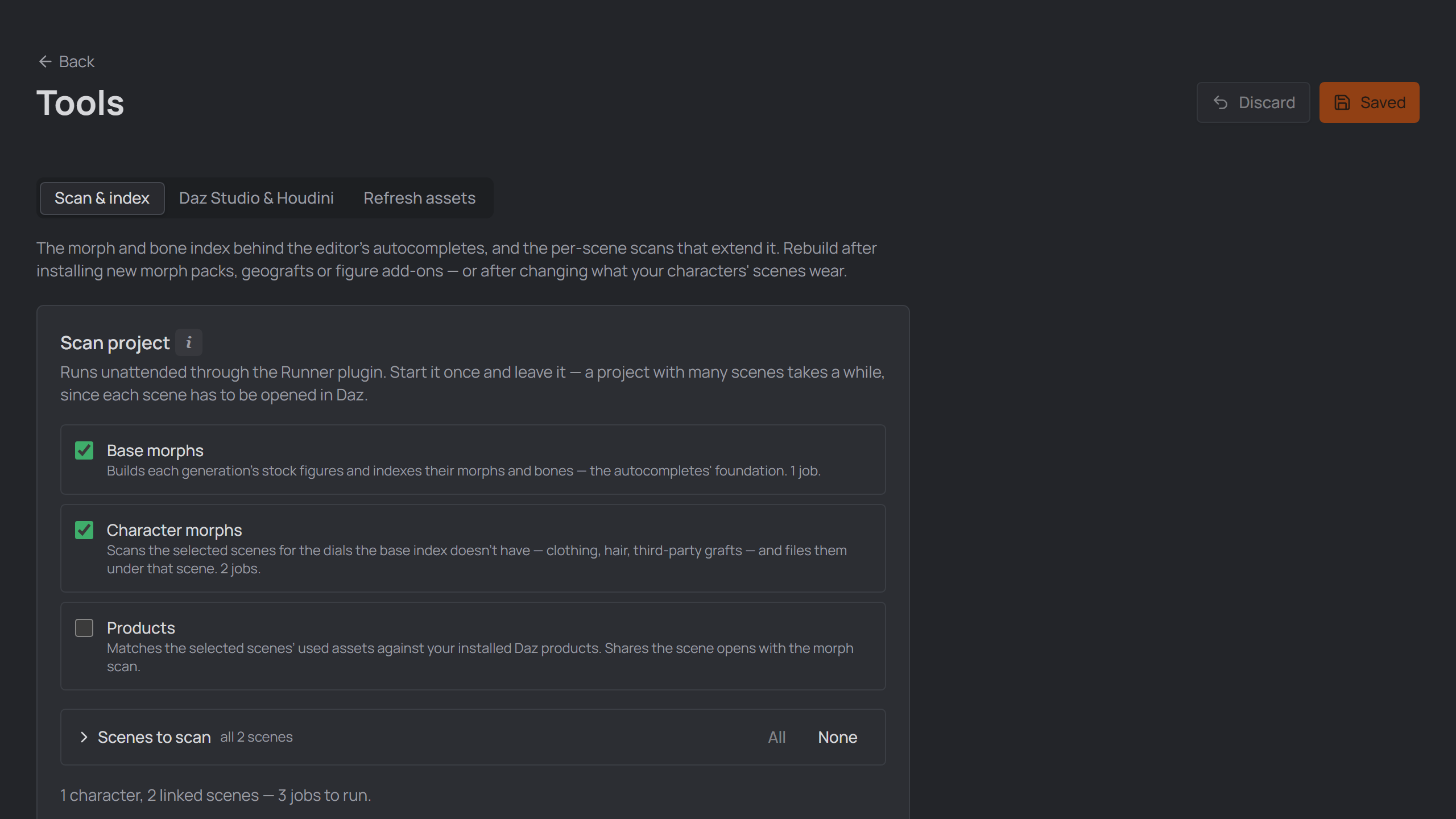
The Tools page and its tabs.
Note
Everything the Daz side needs ships with the studio — the runtime and the
visible scripts (Build_Genesis_Index, Scan_Frames,
Fix_Graft_Shell_Surfaces,
Kill_Animation,
Prepare_For_Transfer)
install into Scripts/DTH-Character-Studio automatically on Save / Refresh
assets. There is no separate scripts download.
Tab 1 — Scan & index#
The morph and bone index behind the editor's autocompletes, and the per-scene scans that extend it. Tick what you want, press Start scan, and leave it. The batch goes through the Runner plugin, so Start stays off until the Runner is installed and My DAZ 3D Library is set in Settings.
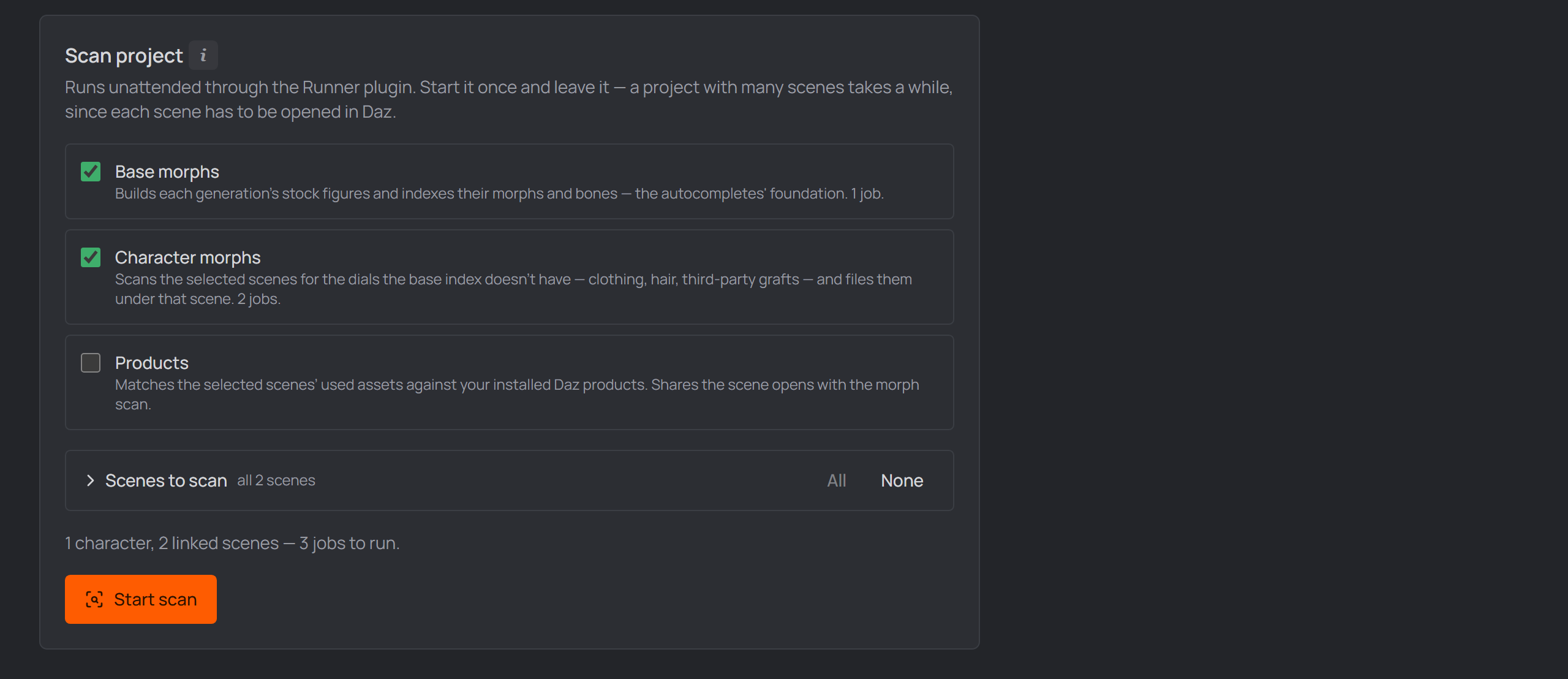
The Scan project panel: tick the passes, press Start scan, leave it.
- Base morphs — builds each generation's stock figures and indexes their morphs
and bones (exactly what
Build_Genesis_Indexdoes). One job, and it runs first, because the scene scans filter themselves against it. - Character morphs — opens every linked Daz scene and indexes the dials the base index doesn't have: fitted clothing, hair, third-party geografts. One job per scene. It needs the base index of its generation, so with none it stops and says so.
- Products — runs the Daz Products scan for the same scenes, once a DAZ Install Manager manifests folder is set. It shares the scene opens with the morph scan, so ticking both costs no extra time.
Scenes to scan — the scene passes default to every linked scene, but each one
is a full Daz open, so a big project is a long run. Expand the list to tick exactly
what you want (per scene, or a whole character at once); the job count updates as
you pick. Scenes whose .duf is missing are struck through and never enqueued.
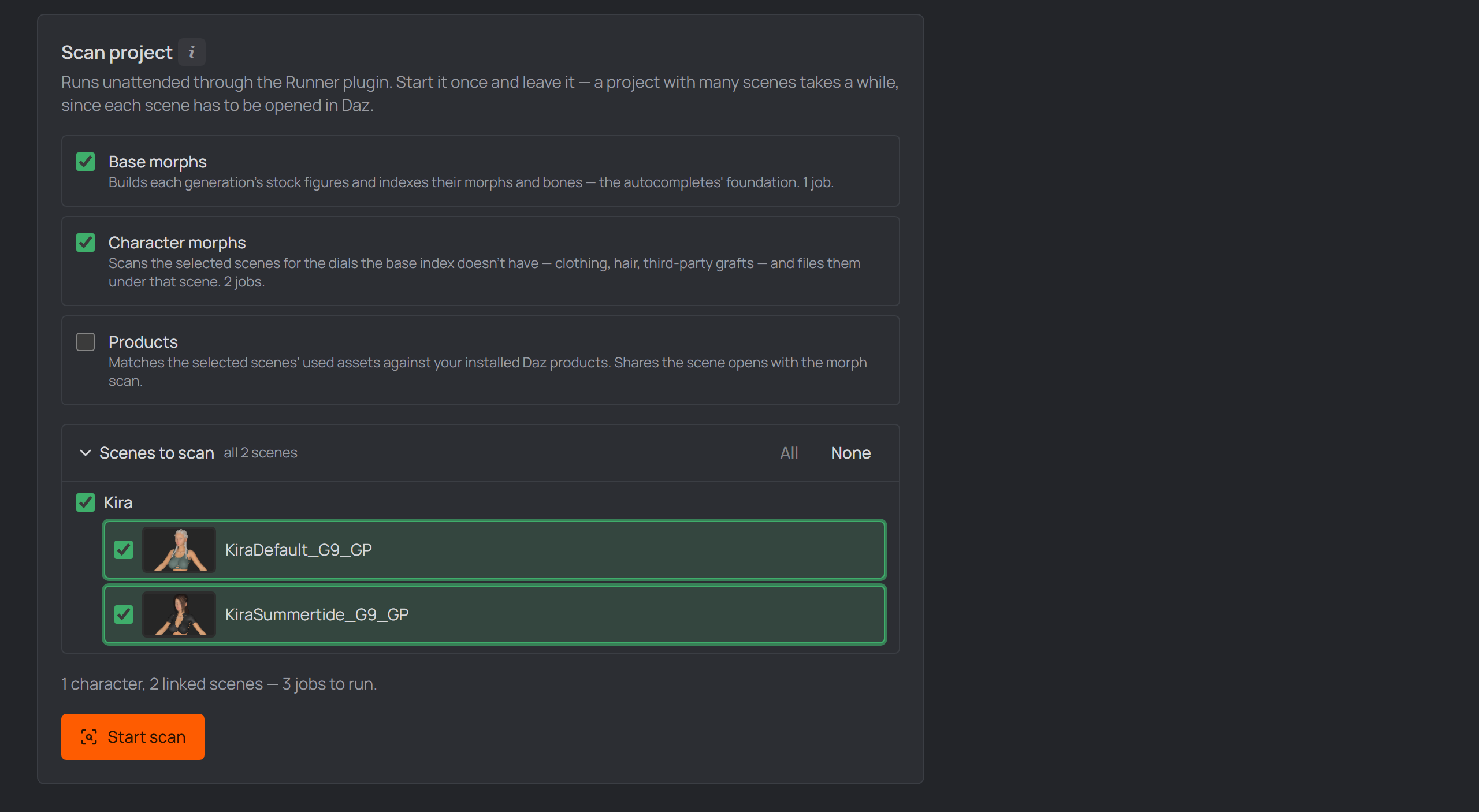
The expanded scene picker: a tri-state box per character, a card per scene.
A Daz the studio has to start for the scan starts minimized; one you already had open is left where it is. While the batch is still waiting to be picked up you can Abort it. From the Home window (no project open) the scene passes are disabled and Base morphs runs on its own.
Note
Scene morphs are scoped to their scene. Two outfits in two scenes both have an Expand All dial, so a scene-scanned morph is only suggested while that scene is selected, marked with a small this scene badge. Morphs the base figure carries are always offered, and re-scanning a scene replaces what it contributed. You rarely have to re-run this by hand: every ROM/export run re-scans the scene it just built.
Tab 2 — Daz Studio & Houdini#
Install your own Daz / Houdini content (not DTH release data). Each section remembers its folders in Settings and installs from them on demand. Dry run everywhere previews without writing.
Daz assets#
Point it at your asset source folders (.zips are extracted). Each asset's
content (data / People / Runtime / Documentation) installs into "My DAZ 3D
Library", skipping what's already there. When two products ship the same file,
newer Genesis wins (by folder name), then the bigger file. Scan lists
what's found; Install copies only what changed.
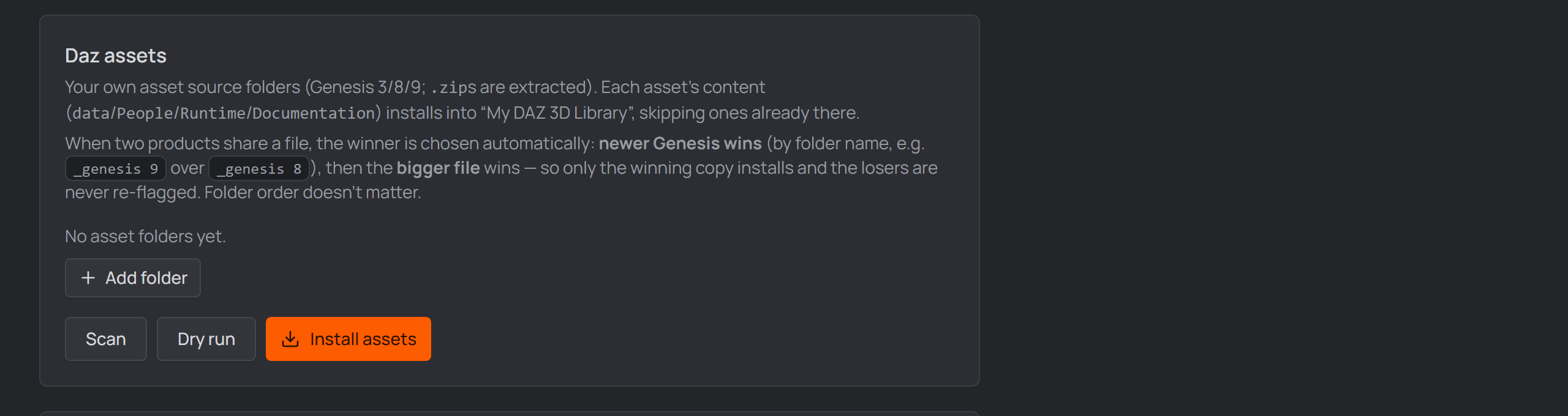
The Daz assets install section.
Deduplicate#
Finds duplicate assets (a folder and its identical .zip, or the same product
at two versions) and conflicting shared files (the same file shipped by two
products at different sizes). Scan previews; nothing changes until you
Apply, and Apply only quarantines — it moves the redundant copies to a
Quarantine folder you set, so it's reversible. Pick one outside your asset
sources.
Shared-file conflicts are never rewritten — that would edit an author's download. You Accept them instead, which tells the scan they're legitimately shared. Wrapper downloads (a zip inside a zip) are looked inside automatically.
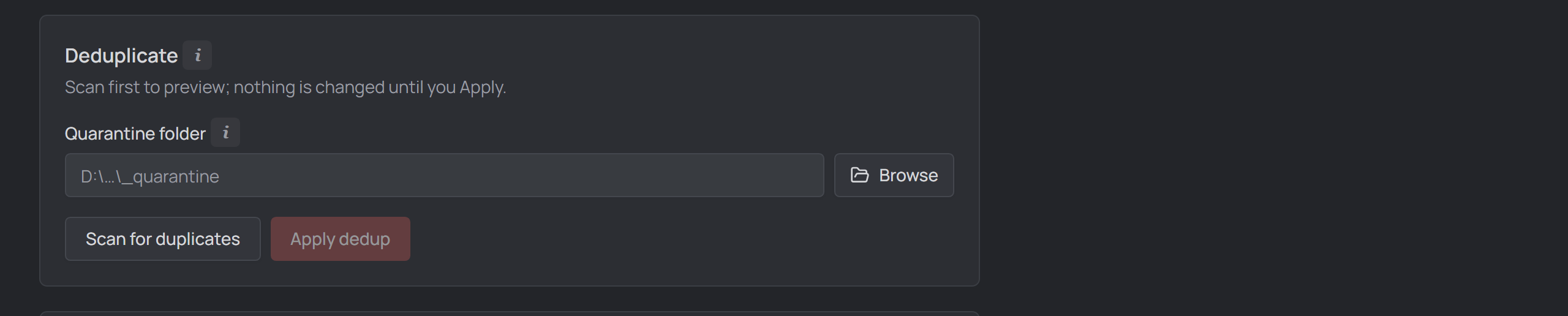
The Deduplicate section for redundant and conflicting assets.
Custom morphs · Daz presets#
Two merge-only installs (add new files, never overwrite your edits): custom morphs made with Daz's Transfer Shape Utility, and your Daz presets.
Houdini presets#
Merges your Houdini my_presets into your Houdini documents folder and wires it
into that version's houdini.env (SHARED_PRESETS + HOUDINI_PATH).
Danger zone#
Caution
After you uninstall Daz Studio / DIM via Windows "Add or remove programs", leftover folders remain. This permanently deletes each listed folder recursively. Use Prefill folder paths to add the standard Daz locations, edit the list, and always Dry run first. As a safety rail the studio refuses to delete a drive/profile root or any folder that isn't Daz-owned.
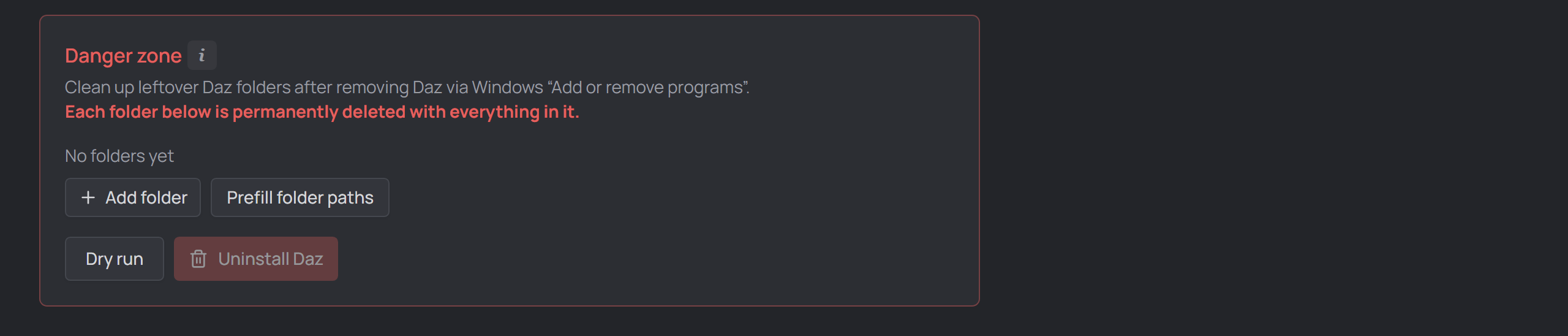
The Danger zone for removing leftover Daz folders.
Tab 3 — Refresh assets#
Re-generates the Daz scripts and PoseAsset CSVs so every generated file matches the current studio/runtime version, migrating older definitions first (your ROM content is preserved). Run it after updating the app or switching DTH release. It covers every known (recent) project, no matter which window you run it from; problems per character are listed inline, and the button pulses orange when a refresh is due. Ctrl+click Refresh also rebuilds every character's stored avatar from its pristine source.
The detection table compares three versions, Local (your files) vs App (what this studio generates):
| Version | Governs |
|---|---|
| DTH Version | the Houdini PoseAsset CSV, the only artifact tied to the DTH release. Pinned to the release's CSV era, so a non-breaking update (2.4.3 → 2.4.4) stays current; only a release that changes the CSV format marks it out of date. |
| Character Schema Version | the character definition (its .json). A newer version means the stored shape changed: the definition is migrated and re-saved, and its scripts and CSV regenerated with it. |
| Script Runtime Version | the generated Daz scripts and the shared DTH runtime files. A newer version means the runtime's call API changed, so the runtime files are reinstalled and every character's scripts regenerated. |
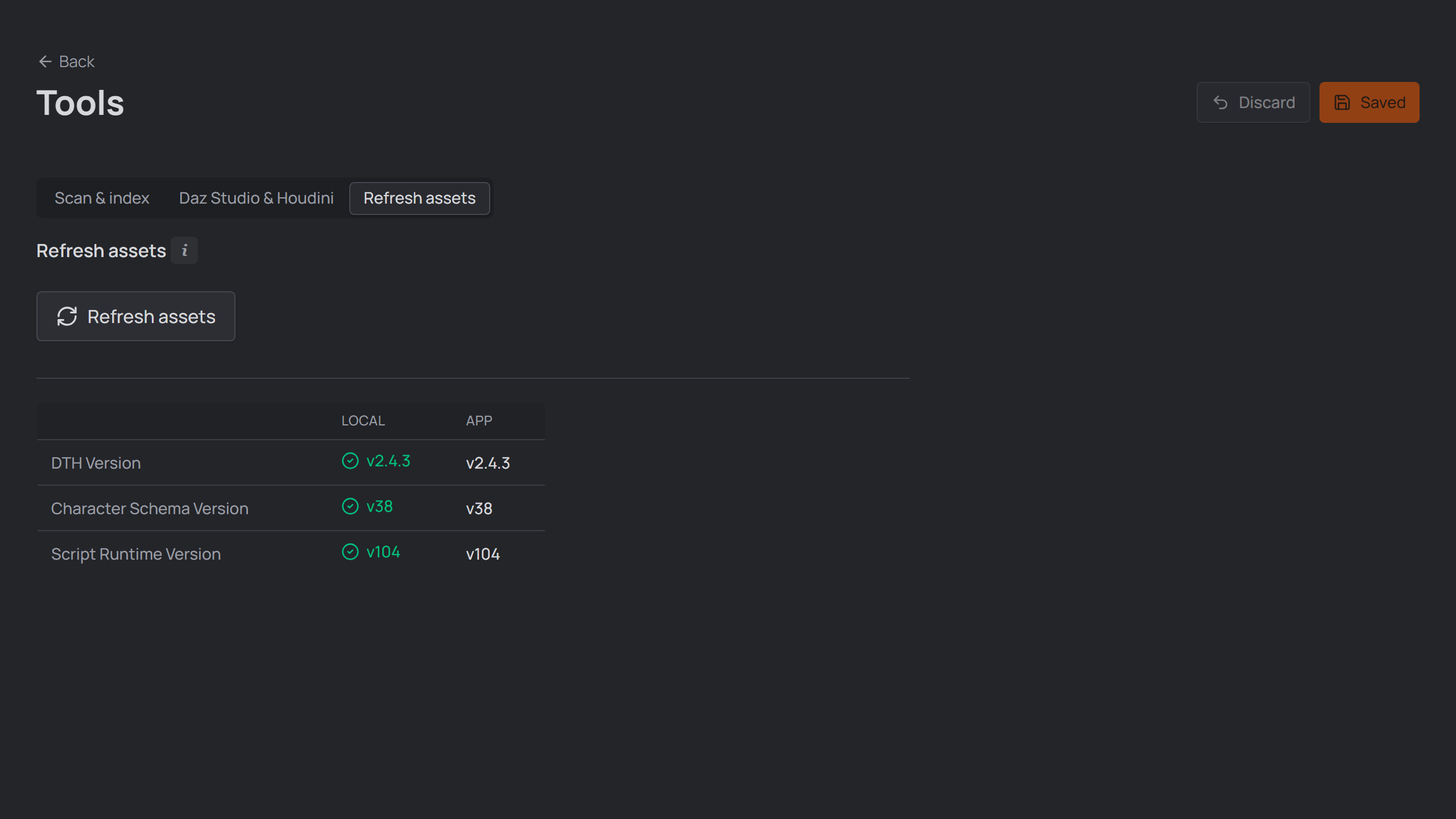
The Refresh assets tab.
…and the Houdini half#
A refresh only fixes the Daz end. Your .hip files keep the DazToHue asset
definitions they were built with, so a new DazToHue release leaves every project on
the old ones until DazToHue's own Refresh Assets runs inside each of them.
So when the studio notices the DazToHue release has changed since it last looked,
the refresh offers to do that too — across every linked Houdini project at once,
through hython, without you opening Houdini. It needs the Houdini installation
folder and its matching documents folder in Settings; without them the offer stays
away.
What it can and can't say, which is the same short list as the per-project button:
- It still isn't a check. Nothing in a project says which DazToHue release its assets came from. What the studio remembers is only which projects it has run this on, and under which release — which is what the dialog's list is: a Last refreshed by the studio column, where a project reads as never rather than as out of date.
- Already done is skipped. A project refreshed under the release that's active now isn't offered again.
- A failed project comes back. If any project fails, the release stays outstanding and the next refresh re-offers exactly the ones that didn't get done — so fixing the cause (usually DazToHue not installed for the Houdini version the studio points at) and refreshing again picks up where it left off.
- Dismissing costs nothing. Not now writes nothing; the offer returns on your next refresh.
A project is copied into its backup/ folder before it's saved — and only then, since
a project the tool leaves unchanged isn't saved at all. Each saved project keeps an
Undo this run button in the report, the way back if you ever need one project on
the previous DazToHue release; undoing also makes the studio stop counting that project
as refreshed, so it's offered again next time. Close the projects in Houdini first:
Houdini writes the whole scene on save and would overwrite the result.
It's one rolling copy per project, which means saving a project replaces whatever copy is already there. Projects that already have one are marked backup at risk in the dialog's list (hover for the file and its date), and the red line underneath says so — "Running may replace 2 existing backups" — with a Let it switch beside it. The run won't start until that switch is on; a dry run isn't held, because it never saves and so never touches a backup. Only the projects the run actually saves lose their old copy, and nothing can say in advance which those are; a project that reports no change, or that fails, keeps the copy it had. If one of those copies is how you'd put a project back on an older DazToHue release, copy it somewhere else first: that dialog is the last point at which it's certainly still there.